
Public space has always carried an implicit promise—that the city belongs, in some meaningful way, to the people who move through it. Too often, the art and infrastructure placed within that space breaks the promise quietly. Benches designed to discourage lingering. Monuments scaled for dominance rather than dialogue. Installations that photograph beautifully and feel, in person, like being asked to admire something that has no interest in you. The question of what public art owes its audience is one that most commissions never bother to ask. Paul Cocksedge asked it—and Please Be Seated is the answer.
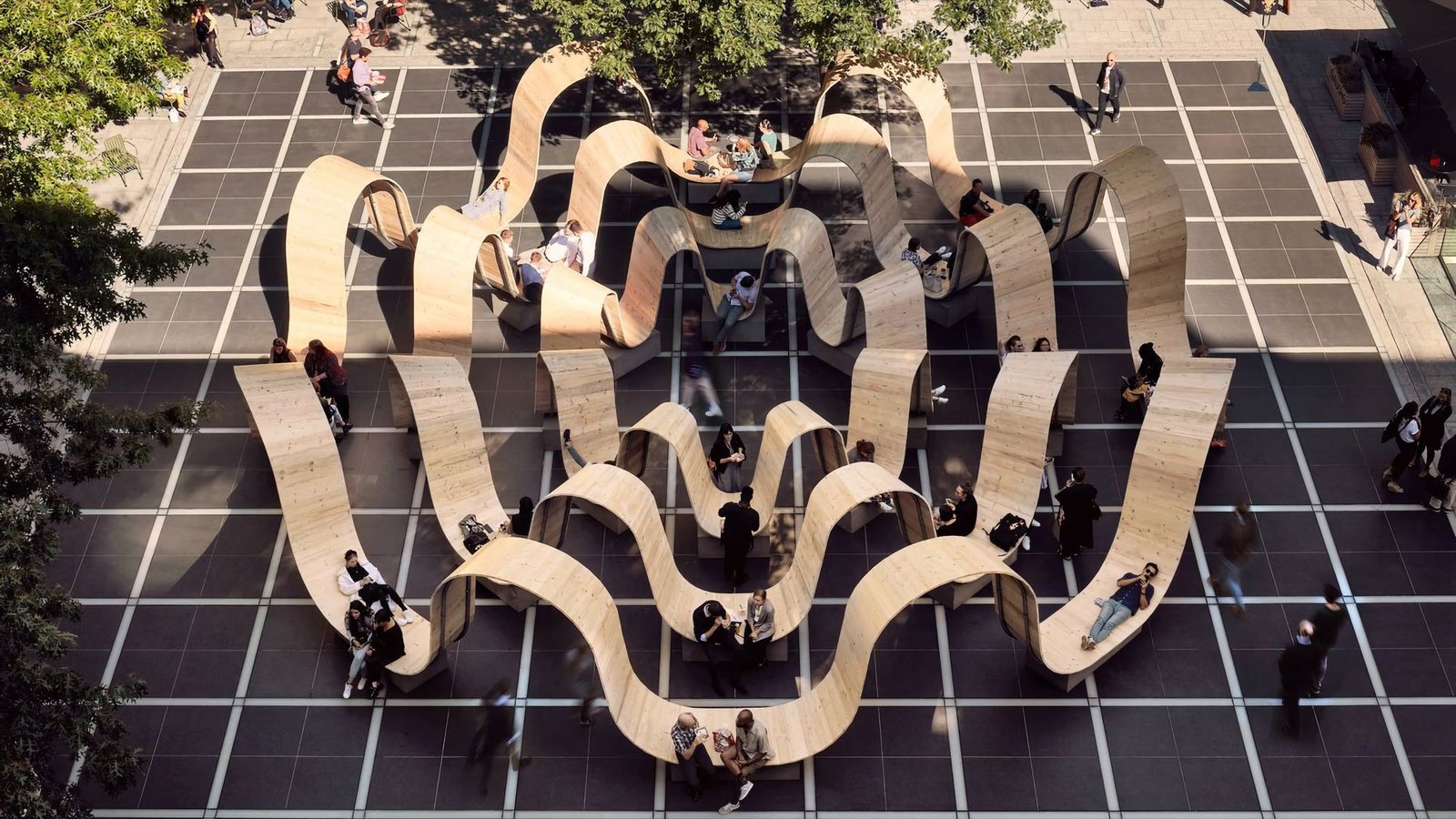
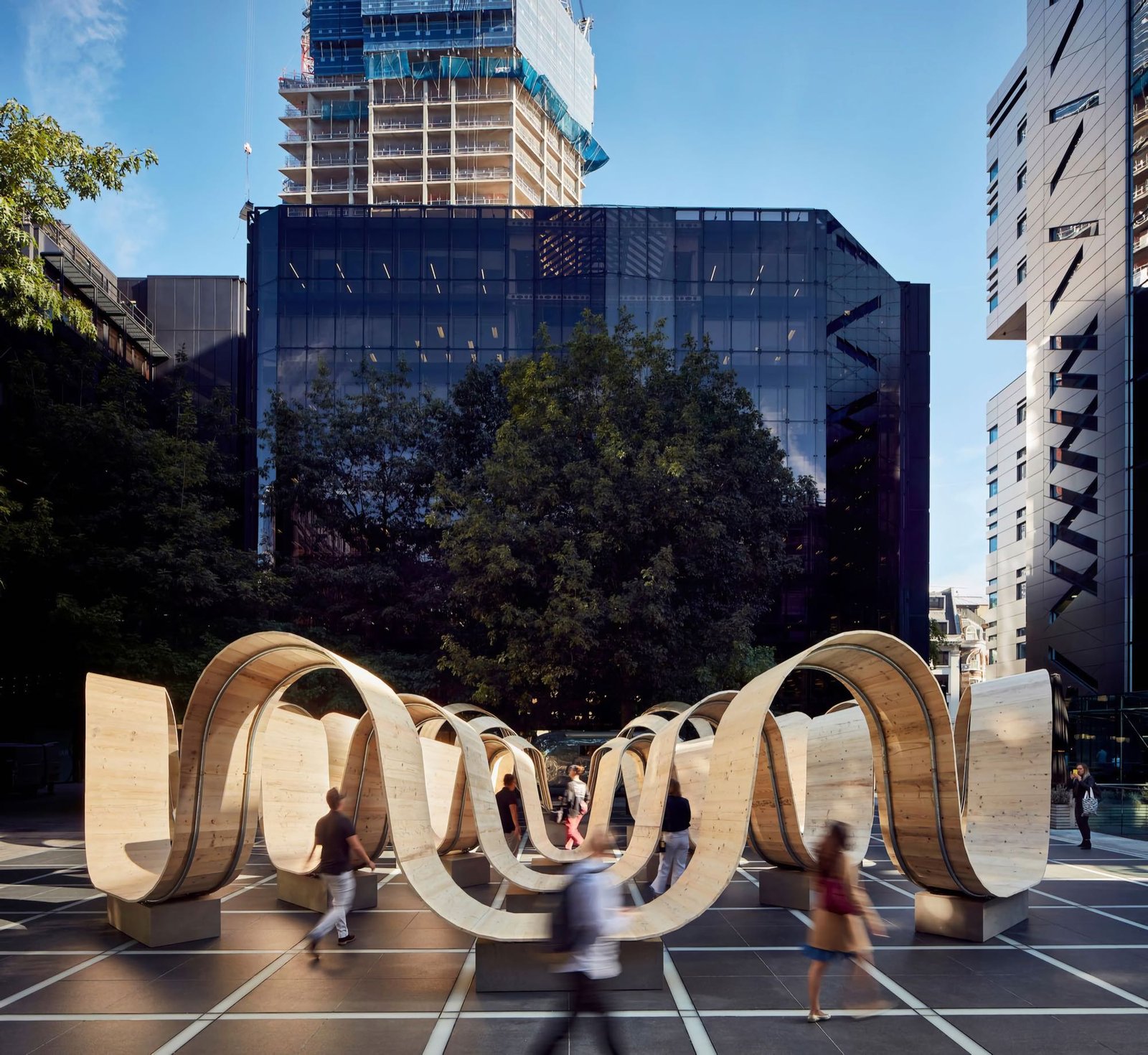
First installed at Broadgate in the City of London for the 2019 London Design Festival, Please Be Seated is constructed from 152 reclaimed scaffolding planks—humble, industrial material transformed into something genuinely graceful. Three concentric rings of undulating forms rise and fall in continuous wave-like curves, creating arches to walk beneath, backrests to lean against, and intimate hollows in which to simply sit. The widest ring spans 15.5 meters; the tallest curve reaches 3.4 meters. The scale is generous without being imposing. “It occupies the square without blocking it,” Cocksedge has said—and this is precisely what so few public installations manage. It fills space while remaining, somehow, porous. Open. Inviting rather than commanding.
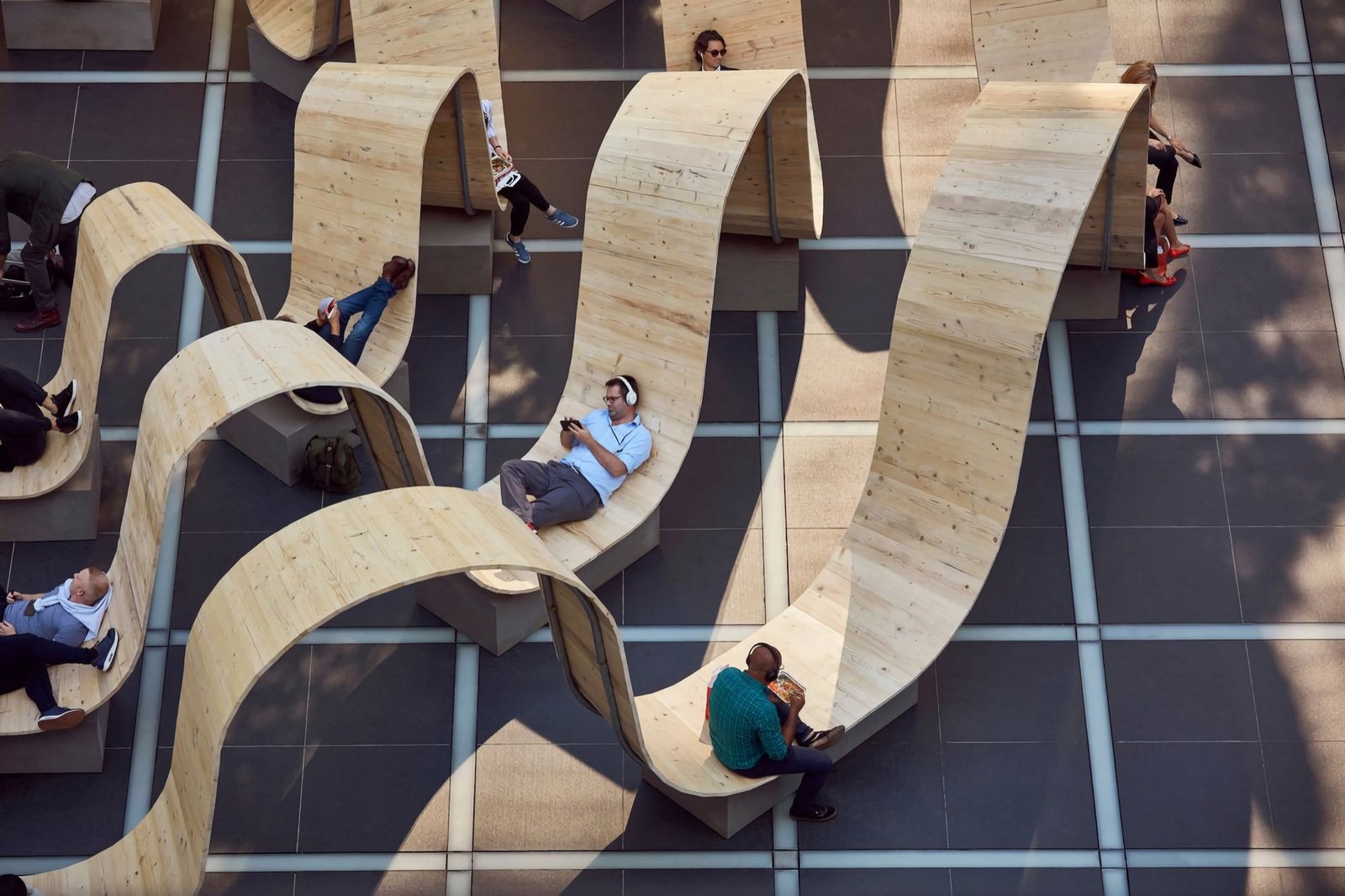
What distinguishes Please Be Seated from so much civic art is the quality of its attention to the individual. The curves are calibrated for the human body—not the abstracted, idealized body of a heroic figure, but a real one, looking for somewhere to rest, to think, to be briefly alone in a crowd. One can sit facing outward into the square or turned inward, cocooned by the gentle rise of wood on either side—intimate, unhurried, entirely self-directed. The installation does not perform at you. It accommodates you. This is a rarer achievement than it sounds.
Consider the contrast. New York’s Vessel at Hudson Yards—Thomas Heatherwick’s copper-clad honeycomb of interlocking staircases—is not without visual ambition. I have, in fact, a polka-dot perforated ceramic vase in my living room—roughly the scale at which the Vessel’s interlocking geometry would have been extraordinary. Translated to sixteen stories, that same beauty becomes something harder to inhabit: a monument that asks only to be looked at. It overwhelms rather than engages, an ode to spectacle that offers the visitor no rest, no shelter, no moment of private contemplation—only the obligation to ascend. It has since been closed repeatedly following multiple suicides, a grim and literal consequence of public design that prioritizes the photographic over the human. The failure is not aesthetic. It is empathic. A city’s shared spaces ask something different of art than a gallery wall does—they ask it to be inhabitable.
Paul Cocksedge, 2020
Taikoo Park, Hong Kong
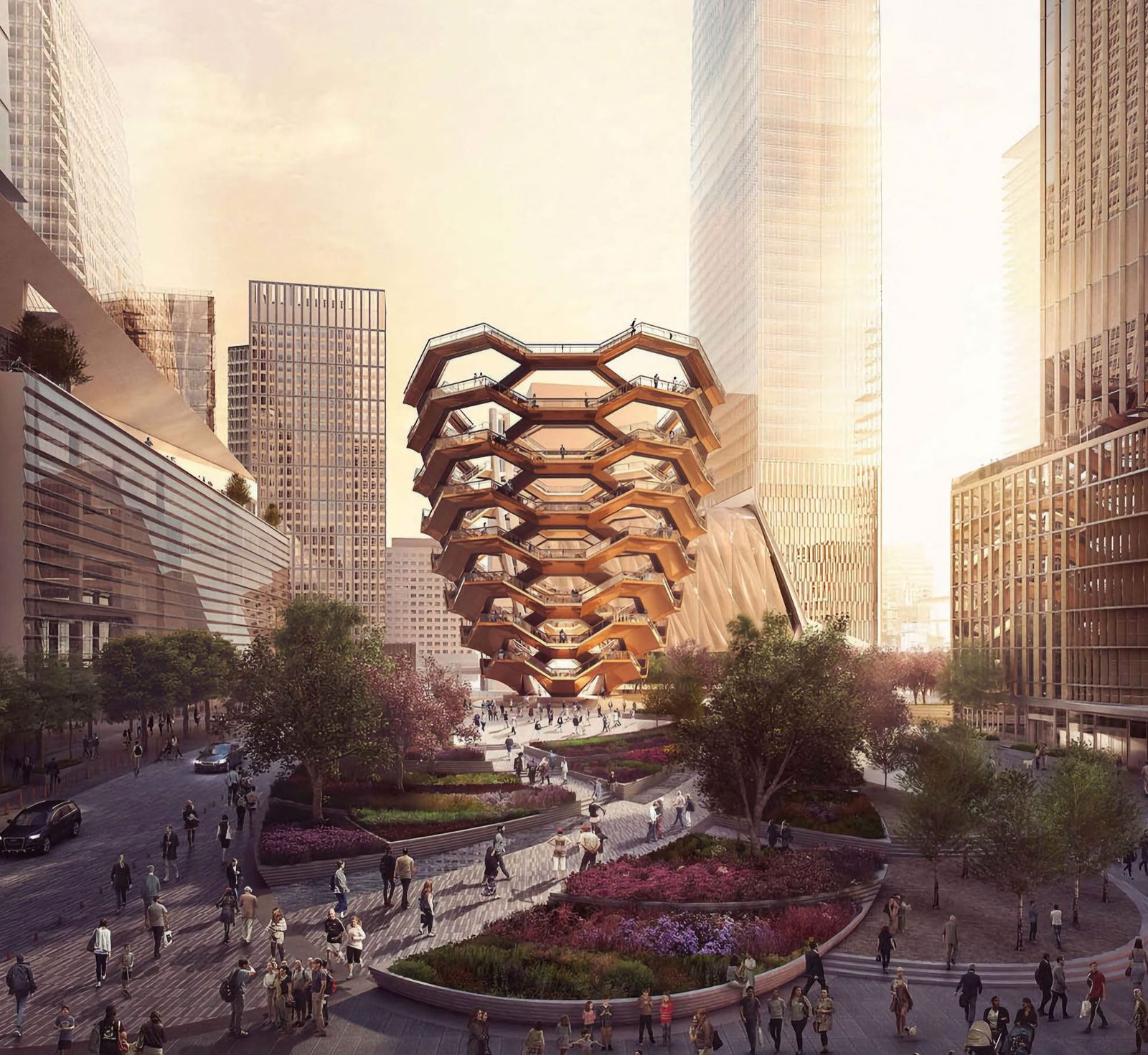
Thomas Heatherwick, 2019
Hudson Yards, New York
Please Be Seated has since traveled—to Chengdu, Guangzhou, Shanghai, and Beijing—and a permanent edition now lives in Hong Kong’s Taikoo Park, testament to a work that transcends its original context without losing its essential character. Wherever it lands, it carries the same quiet proposition: that good public design is not about grandiosity or statement, but about what it feels like to be a person inside it. Warmth, it turns out, is a structural quality. Paul Cocksedge built it from salvaged wood and common steel, and managed to make the city, for a moment, feel like it was built for you.
Photos · Video | Paul Cocksedge Studio
Photo | Heatherwick Studio



 No products in the cart.